
Cooper County Projected Release Dates
A projected release date is an administrative forecast based on the sentence information, credits, minimum terms, and status known at that time. An actual release date records a completed custody event. The distinction is vital in Cooper County because the sheriff's jail and Boonville Correctional Center are separate systems. A transfer from the county detention center to MODOC is continued custody, not a release into the community.
A pretrial detainee ordinarily has no computed sentence end. A bond may be satisfied, the court may order release, a charge may be dismissed, or another hold may keep the person in custody. Case.net may show the legal order, but the detention center's operational record provides the local release time and disposition. For a sentenced prisoner, the judgment, qualifying custody credit, concurrent or consecutive case structure, statutory minimum, and corrections calculation all matter.
Scheduled versus actual: A future date, parole decision, or court order may precede physical release. Confirm departure through the custodian's status change and release record.
- Projected date
- A changeable administrative estimate under current sentence data and law.
- Minimum release date
- The labeled FAK930 date closest to a minimum release point in the historical dataset.
- Conditional release
- A supervised portion of certain Missouri prison terms, not final sentence completion.
- Discharge
- The official end of the represented sentence or supervision.
Find a Cooper County Release Date
Choose the record route by custody type. The Cooper County Detention Center holds local pretrial detainees and some sentenced inmates. Boonville Correctional Center is a MODOC state prison. A county roster cannot calculate or verify a state-prison release, while the MODOC search does not cover an ordinary local booking unless the person later entered state custody or supervision.
- Identify the case and custodian. Use the Cooper County booking, court case number, or DOC number to separate local jail from state prison.
- For a current local detainee, review Case.net for bond, judgment, sentence, dismissal, or release orders, then ask the detention center about the operational status.
- For a sentenced state offender, search the official MODOC active-offender system and reproduce only the exact status and date labels shown.
- If the public MODOC screen omits the needed calculation, contact the institutional caseworker, field officer, Constituent Services, or submit a focused Sunshine request.
- For a past state record, inspect the nightly FAK930 fields and seek the underlying release or discharge document when a definitive result is needed.
The official MODOC Offender Search form is the correct starting point for an active Missouri prison or community-supervision record.
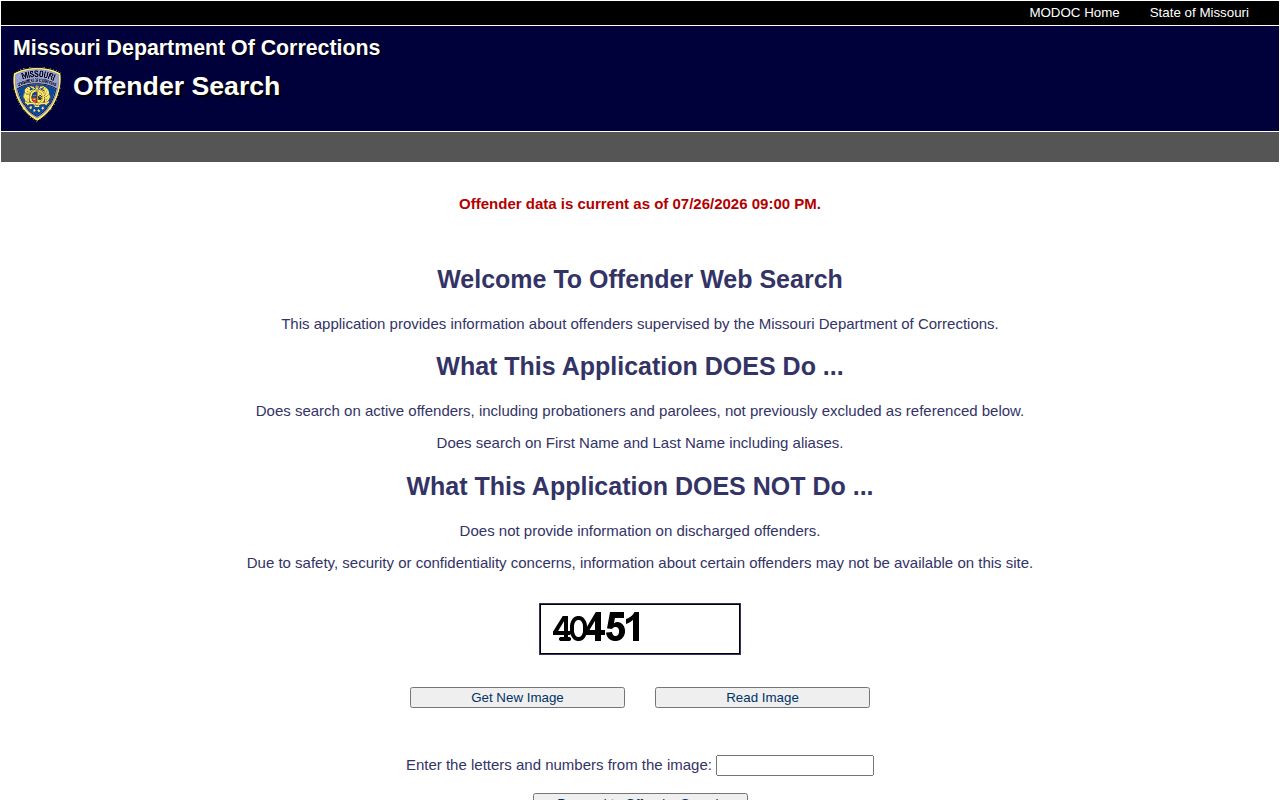
The form searches active offenders, including probationers and parolees. Its disclaimer says discharged offenders are excluded, so a blank result cannot establish final discharge.
The full Cooper County released inmate lookup covers the sheriff, court, and transfer paths when the correct custody system is not yet known.
Cooper County FAK930 Release Fields
MODOC's nightly FAK930 archive is a key Missouri-specific channel for people who are or have been under department supervision. The archive reaches records as early as 1974, subject to department warnings about completeness, accuracy, and system conversions. It is different from the interactive search because it includes historical and discharged-person data. Multiple rows may represent multiple charges or sentences for the same person.
The documented fields include lifetime DOC ID, name, date of birth, assigned place, court cause number, offense and sentence county, charge description, sentence-completed flag, concurrent or consecutive indicator, sentence date, minimum release date, maximum release or expiration date, sentence length, probation date, probation type, and probation term. A completed flag marked “Y” is more relevant to sentence completion than absence from the active search, but it still must be read across all rows tied to the person.
| FAK930 field | Release-date use | Caution |
|---|---|---|
| Sentence-I Minimum Release Date | Closest labeled public analogue to a minimum date | Do not rename it a guaranteed exit date |
| Maximum release/expiration date | Shows the maximum or expiration field | May differ from institutional departure |
| Sentence-completed flag | Indicates whether a sentence row is marked complete | Review every related row |
| Concurrent/consecutive | Shows how terms may relate | Do not compute a date without the official record |
| Probation date/type/term | Shows community-supervision data | Probation is not prison release |
The MODOC Sunshine Law page and FAK930 description are shown below.
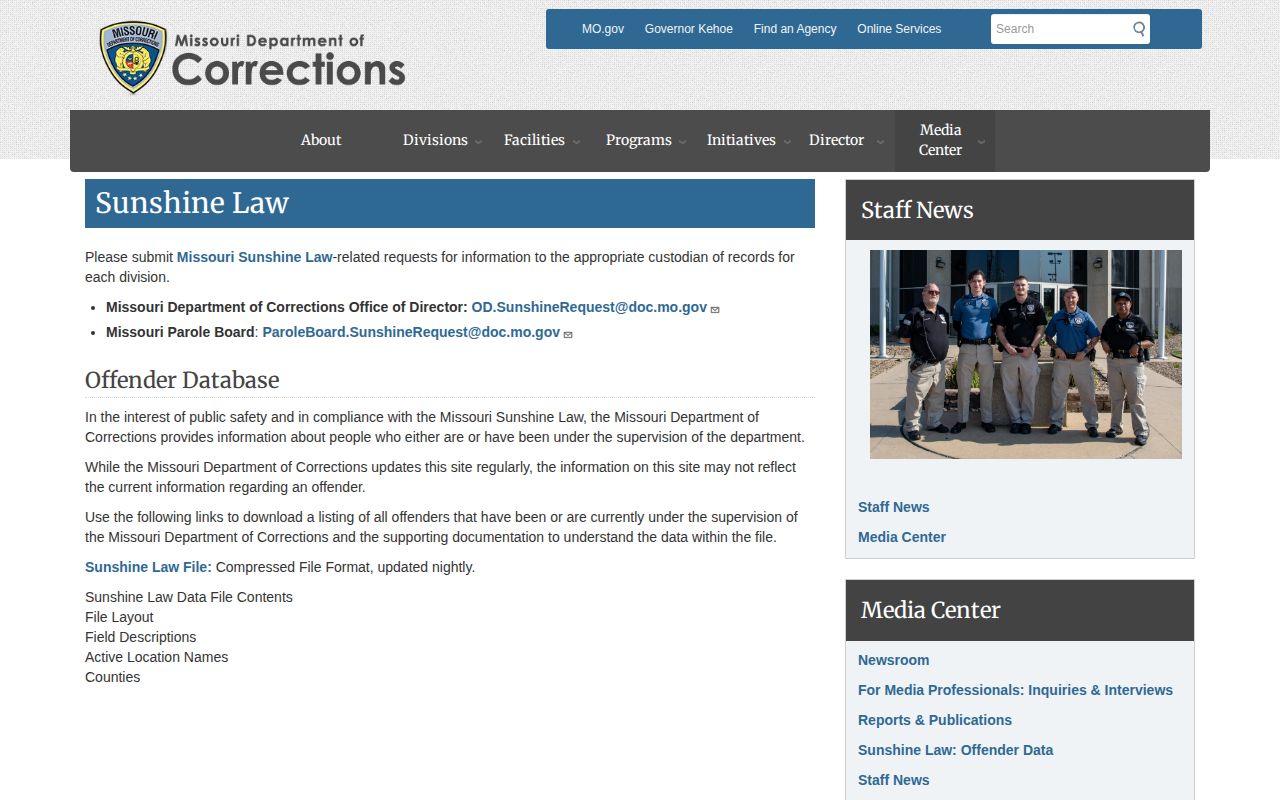
The archive's exact labels prevent a common error: minimum release, maximum expiration, projected time-credit release, and final discharge are related but not interchangeable dates.
Note: A FAK930 row is useful history, but a current release calculation should be confirmed through MODOC or the underlying sentence record.
Missouri Time Credit Release Dates
Missouri does not apply one universal “serve 85 percent” rule. Section 558.019 sets minimum-prison-term provisions for covered circumstances, including a dangerous-felony rule and other repeat-commitment provisions. It does not apply the same percentage to every prisoner. Offense date, statutory version, criminal classification, prior commitments, and the judgment can change the analysis.
Section 558.041 authorizes MODOC, subject to exceptions and a superintendent's recommendation, to award added confinement-day credit for orderly conduct and participation in rehabilitation programs. The implementing rule, 14 CSR 10-5.010, calls the result a “projected time credit release date.” For eligible people, it describes one calendar month per year for Class A or B sentences and two months per year for Class C or D sentences, with a different method for certain parole or conditional-release violators.
Those rates are not a public calculator. The rule has exclusions, preserves statutory minimums, applies credit only to the current sentence, and allows credit to be rescinded for a law or rule violation. The outcome concerns administrative parole or time-credit release under the rule. It does not promise that the person will leave on a date produced by simple arithmetic.
Missouri earned compliance credits under section 217.703 concern eligible people already on probation, parole, or conditional release. They are not prison good time. Cooper County jail labor credit under section 221.160 applies in specified circumstances and also does not support a public county release-date calculator. The sheriff publishes no local good-time formula.
Cooper County Conditional Release Dates
Section 558.011 generally divides a qualifying felony term into a prison portion and a conditional-release portion. For terms of nine years or less, the conditional portion is one-third. For terms over nine through fifteen years, it is three years. For terms over fifteen years, it is five years. Statutory exceptions still apply.
Conditional release means supervised release from the institution. It is not the same as sentence expiration or final discharge. The Board can extend the date through the required process after violations. A MODOC record may therefore show the person outside Boonville Correctional Center but still under state authority in Cooper County or another district.
Parole is different. Under section 217.690, the Board has parole authority subject to statutory limits. A hearing guideline, hearing date, or favorable decision is not a physical release record. Release planning, a minimum term, a detainer, or later Board action can prevent departure on the expected date.
Cooper County Jail Credit Records
Judicial sentence and jail credit form the first layer of a Missouri calculation. The court sets the term. Multiple cases may run concurrently, meaning at the same time, or consecutively, meaning one after another. Section 558.031 addresses qualifying custody credit after the offense and before sentence, based on sheriff certification and without exceeding the actual days held.
For a Cooper County sentence, Case.net can show the judgment and related docket events. The sheriff or sentencing record supplies the operational custody and credit facts. For a MODOC sentence, the official calculation follows the transmitted judgment, certification, and department record. A booking date subtracted from a sentence length does not account for multiple cases, excluded time, minimum terms, or later legal events.
Pretrial time also should not be confused with a projected release date. A current detainee may leave through bond, recognizance, dismissal, court order, or another authority's action. Another warrant or detainer can block a walk-out even after the Cooper County case permits release. Ask the detention center for current custody and the release disposition rather than projecting an exit from the docket alone.
Why Cooper County Release Dates Change
A future date changes when an input changes or another authority prevents the expected release. The safest practice is to record the exact date label, the source, and the date it was checked. Never convert a tentative, minimum, or conditional date into a claim that physical release occurred.
| Factor | Possible effect | Verification source |
|---|---|---|
| Credit award or rescission | Moves the projected time-credit date | MODOC calculation or caseworker |
| Concurrent or consecutive correction | Changes how sentence terms combine | Judgment and MODOC sentence record |
| Detainer or another warrant | Prevents community release or causes transfer | Custodian and receiving authority |
| Amended court order | Changes sentence or release authority | Case.net and certified order |
| Parole Board action | Sets, delays, rescinds, or revisits parole | Board decision and active MODOC status |
| Violation or revocation | Extends custody or returns a supervisee | MODOC and court record |
A future date is best treated as a current official projection. Check it again close to the expected event, and ask whether another hold or receiving agency appears. The sheriff's local release record, MODOC status change, or discharge document is stronger evidence after the date has passed.
Confirm Cooper County Actual Release
For the Cooper County Detention Center, seek the date and time of release, release disposition, and receiving authority when applicable. Pair that record with the court order that authorized the local departure. For Boonville Correctional Center, check the active MODOC status and location, then use an underlying release, parole, conditional-release, or discharge record if the exact legal event matters.
A pending event can also be monitored through the Cooper County VINE inmate check, but VINE is a notification service and may lag. Its reported event should be corroborated with the listed custodian. A MODOC active-parole result confirms community supervision, not final discharge. A completed FAK930 row requires review of all related sentence rows.
When the public interface does not expose the calculation, request the specific record instead of manufacturing a date. Identify the person and DOC or booking number, name the desired field or document, give the relevant date range, and ask for an electronic copy. A clear request for a release certificate, sentence calculation, minimum-release field, or discharge record is more useful than a broad demand for every file.
Public Record Search
Sponsored Results